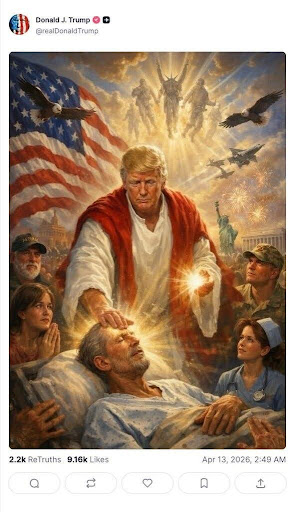
A public clash between President Donald J. Trump and Pope Leo XIV, the first American to lead the Catholic Church, escalated over the weekend after the president posted a series of social media messages criticizing the pontiff and then shared an AI-generated image that many observers said depicted the president as Jesus Christ. The posts received condemnation from religious leaders, conservative commentators, and some of the president’s own allies, and the image was removed from the president’s account within hours.
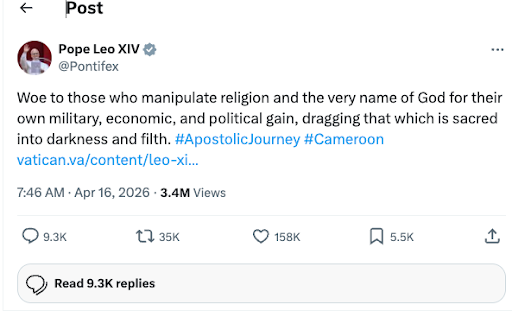
This dispute marks the latest chapter in the deterioration of relations between the White House and the Vatican. Tensions between them began to surface after Pope Leo XIV publicly questioned the administration’s handling of the war in Iran, urging world leaders to “reject the logic of domination.” The pope repeatedly emphasized humanitarian concerns in regions affected by U.S. military operations, which resulted in Trump responding with increasingly intense rhetoric, accusing the pontiff of meddling in U.S. policy and failing to support U.S. strategic interests.
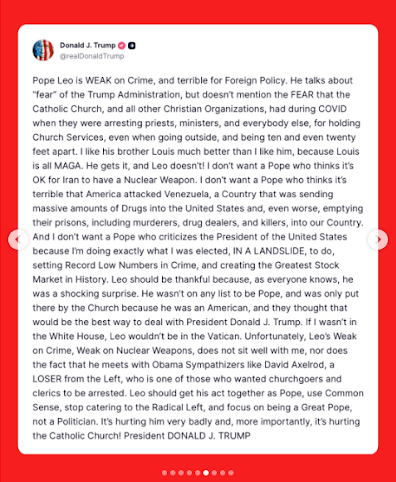
On Sunday night the president published a long message on Truth Social in which he called Pope Leo XIV “WEAK on crime” and “terrible for Foreign Policy,” adding that “if I wasn’t in the White House, Leo wouldn’t be in the Vatican.”
Trump also criticized the pope’s stance on the war in Iran, saying, “I don’t want a Pope who thinks it’s OK for Iran to have a Nuclear Weapon.” The post followed public remarks by the pope criticizing the escalation of the U.S.-Israel war in Iran and warning against what he called a “delusion of omnipotence.”
Shortly after the written post, Trump shared an AI-generated image showing him in white robes placing his hand on a bedridden man while a glowing light shone from his other hand. When questioned by reporters, Trump insisted the image was misunderstood, saying, “It’s supposed to be me as a doctor making people better… And only the fake news could come up with that one.” He also said he would not apologize, stating, “I don’t want a Pope who criticizes the President of the United States.”
Pope Leo XIV responded during a flight to Algiers, saying, “I have no fear of the Trump administration.” He added that his appeals for peace were rooted in the Gospel, not politics: “I will continue to speak out loudly against war… Too many innocent people are being killed. And I think someone has to stand up and say there’s a better way.”
Vatican officials later emphasized that the pope’s remarks were consistent with the Church’s teaching on war and human life.
The president’s comments and the AI image drew criticism from Catholic leaders across the United States. Archbishop Paul S. Coakley, president of the U.S. Conference of Catholic Bishops, said, “I am disheartened that the President chose to write such disparaging words about the Holy Father. Pope Leo is not his rival; nor is the Pope a politician. He is the Vicar of Christ who speaks from the truth of the Gospel and for the care of souls.”
Minnesota Bishop Robert Barron, a member of the president’s Religious Liberty Commission, said the president’s remarks were “entirely inappropriate and disrespectful,” adding, “I think the president owes the pope an apology.”
Archbishop George Leo Thomas of Las Vegas also defended the pontiff, saying he was “grateful to God for sending us Pope Leo XIV, who is willing to speak truth to power just when we need him the most,” and adding that the pope was “calling for dialogue over diatribe, prayer over politics, and diplomacy above destruction.”
This near-universal backlash extended into conservative media and among some of Trump’s usual supporters. Brilyn Hollyhand, a former Republican National Committee Youth Advisory Council co‑chair, wrote, “This is gross blasphemy. Faith is not a prop. You don’t need to portray yourself as a savior when your record should speak for itself.”
Conservative activist Riley Gaines also criticized the post, writing, “Does he actually think this? Either way… God shall not be mocked.”
Vice President J.D. Vance, one of the only prominent public figures to defend the president, said the pope should “stick to matters of morality,” framing the situation as a case of religious leaders delving into political commentary. Vance was also briefly heckled at a Turning Point USA event on Tuesday after remarking that the pope should “be careful” talking about “matters of theology.” His defense of Trump’s action stands out among the wave of condemnation from religious leaders and conservative commentators.
Political analysts say the controversy could complicate relations between the White House and the Vatican at a time when the pope has been vocal about international conflicts tied to U.S. policy. It may also risk alienating religious voters who have been a key part of the president’s coalition.
As the pope continues his scheduled international visits, Vatican officials will maintain their focus on the pastoral priorities of diplomatic engagement.